

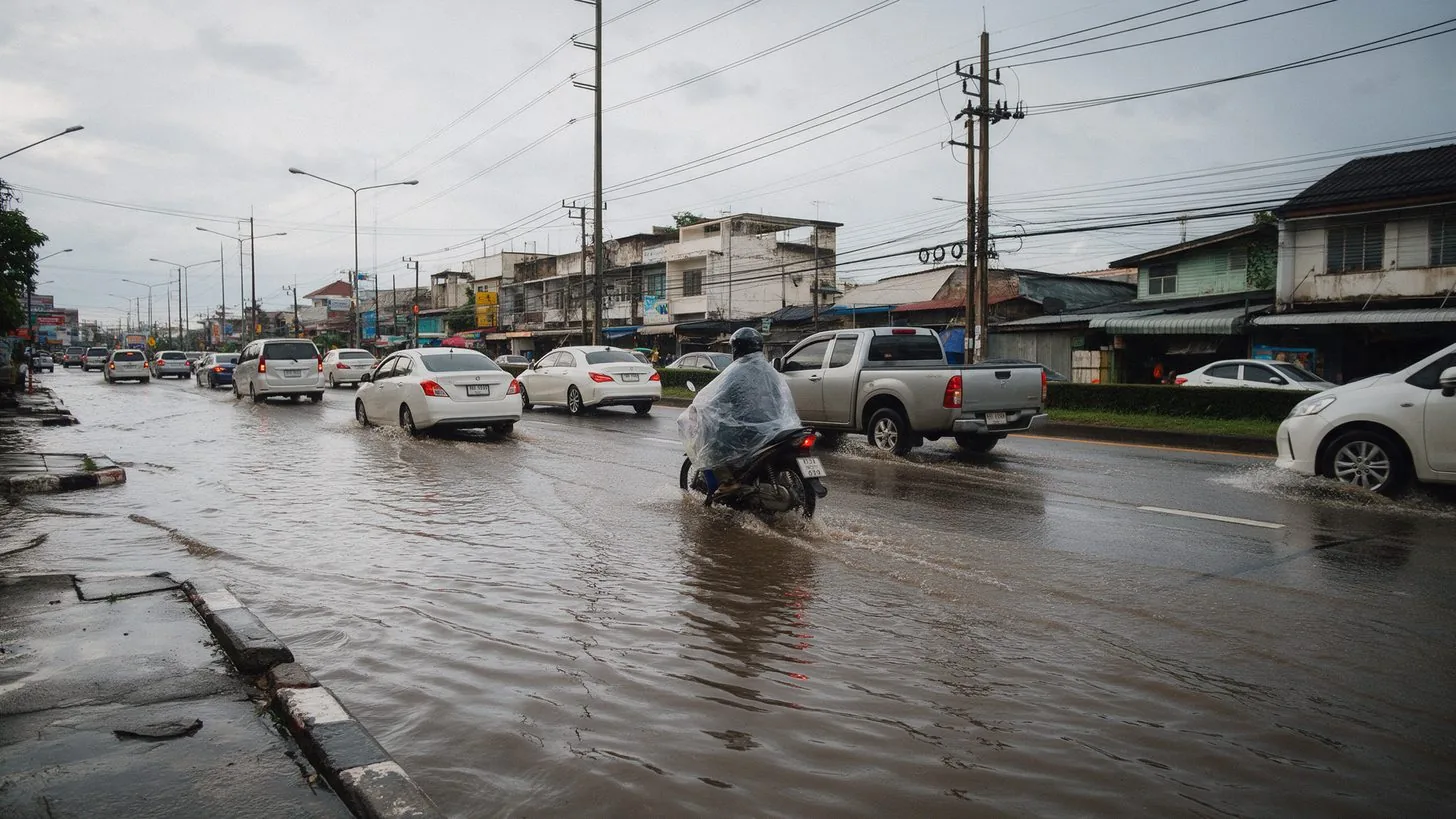
Bangkok's governor declared all 50 of the capital's districts flood-affected on 26 September, after close to 300 millimetres of rain fell between Thursday afternoon and Saturday morning. Both Bangkok airports stayed open throughout. What failed was the ground around them: waterlogged roads, suspended taxis at Don Mueang and slow approaches to Suvarnabhumi. This brief, from a Thailand DMC for travel agents, sets out what is confirmed, what to tell a client with a flight this week, and what to hold back until the water drains.
Update, 30 September 2026 — Thai Airways is cutting flights and has stopped taking cargo at Suvarnabhumi. The Nation reported on 30 September that Thai Airways had cancelled about 75 flights and that more than 1,000 transit passengers were stranded at Suvarnabhumi, because flooding kept staff from reaching the airport. The airline also stopped accepting cargo at its Suvarnabhumi warehouse until 6 October, with exceptions such as diplomatic mail, live animals and human remains; reports differ on whether the halt began on 30 September or 1 October. Its recovery plan, as reported, is to cut a further 15 flights on 1 October and return to 105 outbound flights a day on 2 October, against a normal schedule of about 115. For a client connecting in Bangkok on Thai Airways this week, choose a longer connection over a tight one, recheck the flight on the day, and use the free date change in the 28 September update if the dates can move. Samples or event material due to travel as Thai Airways cargo in the next week need another carrier or a later date.
Update, 29 September 2026 — the water is going down, and the problem has moved to the Suvarnabhumi baggage hall. With no fresh rain, floodwater has begun to recede and traffic is moving normally again across much of Bangkok, although some communities and lanes remain under water. The east is still the slowest to drain: pumping continues in Lat Krabang, Nong Chok and Min Buri, and Governor Chadchart Sittipunt has announced a targeted pumping operation for the worst-hit communities. At Suvarnabhumi the disruption is now in baggage handling rather than on the approach roads. Thai Airways said on 29 September that baggage from 52 of its flights operated on 26–27 September was still being processed and delivered, with military personnel helping to clear it; the airline has cancelled further flights, and its chief executive has apologised to passengers. For clients flying Thai Airways this week, advise packing essentials in hand luggage, reconfirm the flight on the day of travel, and remember the airline’s free date change described in the 28 September update.
Update, 28 September 2026 — the rain has eased, eastern Bangkok is still under water, and today and tomorrow are public holidays. Governor Chadchart Sittipunt said on 27 September that conditions were beginning to improve and that main roads could clear within a few dry days, but flooded residential communities may take around two weeks to dry out. The east is the slow part: water in Lat Krabang and Min Buri has not receded, because runoff and high tides keep canals such as the Saen Saep full, and Lat Krabang has been evacuating residents. That is the district a Suvarnabhumi transfer crosses, so keep routing clients by Motorway 7 or the Burapha Withi Expressway rather than the Lat Krabang approach. The Cabinet declared 28 and 29 September special public holidays in Bangkok, Nonthaburi, Pathum Thani and Samut Prakan, so expect government offices to be closed and move any immigration or document appointment; the Expressway Authority of Thailand has extended its toll waiver to midnight on 29 September. Both airports remain open. Suvarnabhumi has reported flight delays and a baggage backlog because ground staff struggled to reach work, so tell clients to allow extra time at baggage reclaim as well as on the road. Thai Airways is allowing one free date change on tickets issued by 26 September for flights to or from Suvarnabhumi between 26 September and 11 October, with travel completed by 11 October. The forecast is for less rain in Bangkok, with isolated heavy showers still possible.
Explera DMC is a TAT-licensed ground handler (TAT licence 14/05119, IATA 96215733) trusted by 4,500+ agency partners, with in-house transport, licensed guides and 24/7 support. Reach the trade desk at b2b@explera.co.th.
What is confirmed
Governor Chadchart Sittipunt declared every Bangkok district a disaster-affected area on Saturday 26 September. Reporting that day put at least 93 roads out of use, including sections of Vibhavadi Rangsit and Ramkhamhaeng, with the worst flooding in communities along the Don Mueang, Lat Phrao and Saen Saep canals and in the neighbouring provinces of Samut Prakan, Pathum Thani and Nonthaburi. The Thai Meteorological Department warned that rain would continue across most of the country through Sunday, and the governor said drainage would take two to three days once it eased. BMA schools are closed on Monday 28 September and non-essential city staff are working from home to keep traffic off the roads.
The airports are the part a client asks about first, and the answer is better than the headlines. At Don Mueang, water collected on part of the southern taxiway on 26 September; Airports of Thailand said aircraft were taking off and landing normally, airlines were told to avoid the affected section, and no schedule change was needed. TAT's visitor update on the morning of 27 September listed both Suvarnabhumi and Don Mueang as operational.
What to tell a client flying this week
The flight is not the risk; the road to it is. TAT's 27 September update asks travellers to allow three hours before an international departure and two before a domestic one. For Suvarnabhumi it advises avoiding the Lat Krabang approach and using Motorway 7 or the Burapha Withi Expressway instead. For Don Mueang it points to the Don Muang Tollway, and notes that metered taxis there were temporarily suspended while the BMTA A1 to A4 airport buses kept running with delays.
Rail is the steadier option where it reaches. The same update lists the Airport Rail Link as operating normally, the MRT and BTS as alternatives to congested roads, the SRT Red Line back in normal service from 09:30 on 27 September, and the State Railway's northern line reopened. Interprovincial buses were disrupted; a client on a road transfer out of Bangkok should expect a longer day or a changed departure time.
Pre-booked transfers should move earlier, not be cancelled. A transfer with a driver who knows which roads are open this morning is worth more this week than it usually is. Ask your Thailand DMC to re-time every airport run due in the next three days and to confirm the route the evening before.

What to hold back until the water drains
Three things should not go into a client message on the strength of this weekend's reporting. Do not promise that a specific road, hotel entrance or attraction is dry, because conditions changed hour by hour and the published road list will be out of date before your client reads it. Do not quote a firm reopening date for anything the city has closed; the only timing on record is the governor's two-to-three-day estimate for drainage once the rain stops. And do not describe the city as closed: most of Bangkok's hotels, rail lines and both airports kept operating, and a client told otherwise may cancel a trip that would have run.
For groups already in the city, the practical changes are smaller than they sound. Swap outdoor and canal-side programme items for indoor ones for the next two or three days, keep coach movements to expressways and main roads, and hold a little extra time on every transfer. Our transportation team re-routes on the day rather than on the rate sheet, which is what a week like this needs.
Insurance, changes and cancellations
Whether a client can change or cancel without penalty depends on their own policy and on the supplier terms of each service, not on the disaster declaration. The declaration is a public-administration step that releases city resources; it is not a travel ban and it does not by itself trigger refunds. Read the client's policy wording for weather and "declared disaster" clauses before you promise anything, and document every change you make on their behalf. Our note on making weather calls and handling cancellations sets out the order to work through, and the guide to reading Thai weather warnings explains which official source to watch.

Who to call, and what the ground partner does
The official numbers worth passing to a client in Bangkok this week are the TAT Contact Centre on 1672, the Tourist Police on 1155, the State Railway call centre on 1690 and the Thai Meteorological Department on 1182. For your own files, the ground partner is the faster route: a Thailand DMC with drivers on the road can tell you by phone which approach to the airport is moving, which is information no website carries in real time. Our 24/7 emergency support desk handles re-timing and re-routing for groups on the ground, and the full list of Thailand DMC services covers the rest of a disrupted file. Send any affected booking to the trade desk with the flight details and we will confirm the transfer plan the same day.
More from Explera, your Thailand DMC: Bangkok DMC
Sources
Frequently asked questions
Are Bangkok's airports open?
Yes. TAT's visitor update on 27 September listed Suvarnabhumi and Don Mueang as operational, and Airports of Thailand said flights at Don Mueang ran normally on 26 September despite water on part of a taxiway. The disruption is on the roads leading to both airports, so the practical advice is to leave earlier, not to rebook.
How early should a client leave for the airport?
TAT advises allowing three hours before an international flight and two before a domestic one. For Suvarnabhumi, avoid the Lat Krabang approach and use Motorway 7 or the Burapha Withi Expressway; for Don Mueang, use the Don Muang Tollway. The Airport Rail Link was operating normally and is often the quicker way in.
Does the disaster declaration mean clients can cancel for free?
Not by itself. The declaration is an administrative step that lets the city deploy resources; it is not a travel ban. Refund and change rights depend on each supplier's terms and the client's own insurance policy, so check the wording before promising anything.
How long will the disruption last?
No official end date has been published. The governor estimated two to three days for drainage once the rain eased, and the Meteorological Department forecast rain through Sunday 27 September. Plan for slower roads into the start of the week and re-check each morning rather than committing to a date.
Should groups already in Bangkok change their programme?
Adjust it rather than abandon it. Move outdoor and canal-side items indoors for two or three days, keep coaches on expressways and main roads, and build extra time into every transfer. A ground partner can re-route on the day as roads reopen.